quote from platts
China’s exports of semi-finished and finished steel may continue to show weakness in March and April after experiencing an on-year decline in January and February, according to China-based trading and mill sources.
A key reason is that, following disruptions to shipping in the Strait of Hormuz, the vast majority of exports to the Middle East have paused.
Market participants are concerned that if the conflict in the Middle East persists and keeps global energy costs elevated, it could slow down global economic growth and further dampen overseas demand for Chinese steel.
At the same time, pressure of antidumping cases on China’s steel exports may become more apparent in 2026, market participants said.
Exports fall in Jan-Feb
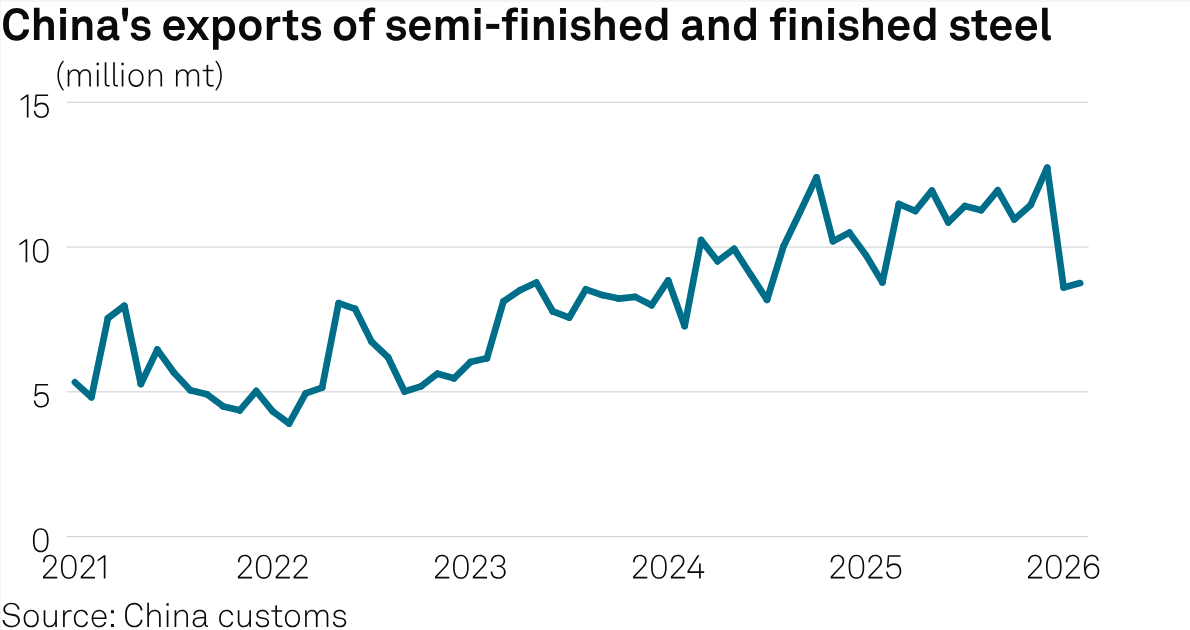
China’s exports of semi-finished and finished steel in January and February fell by 6.2% year over year, or 1.14 million metric tons, to 17.365 million mt, accounting for 10.8% of China’s crude steel production of 160.34 million mt in the first two months of 2026, the latest data from China customs showed.
The daily exports over January-February also fell by 28.4% from December 2025 at 294,319 mt, hitting the lowest daily average since July 2024.
In January-February, imports of semi-finished and finished steel fell 14.5% year over year to 1.027 million mt.
Consequently, China’s net exports of semi-finished and finished steel reached 16.338 million mt in the first two months, down 5.6% from a year earlier.
Some trading sources said that as people tried to secure customs clearance by the end of 2025 to avoid the hassle around the implementation of export licensing on Jan. 1, 2026, the retreat in Chinese steel exports during January and February was in line with market expectations.
The traders said that they had previously expected steel exports to gradually recover in March and April as the disruption caused by export licensing to China’s steel exports diminished.
However, as shipping disruptions in the Strait of Hormuz persist, this hope has already been dashed, participants say.
Export outlook
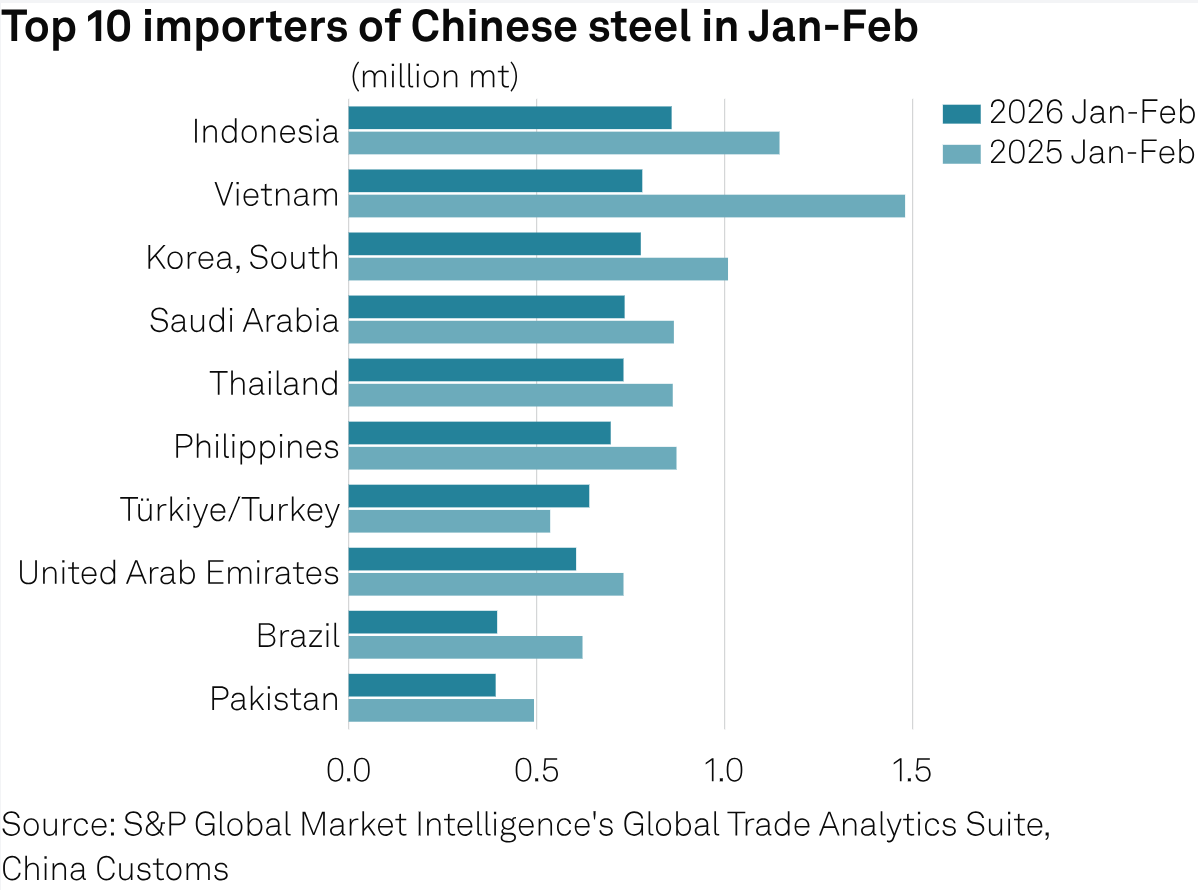
Several trading sources said China’s steel exports to Persian Gulf states have almost completely paused, which could lead to a notable year-over-year decline in China’s exports in March and April.
China exported a total of 12.034 million mt of steel in 2025 to seven Persian Gulf states, averaging about 1 million mt/month, data from S&P Global Market Intelligence's Global Trade Analytics Suite showed.
Meanwhile, steel export loading volumes at Chinese ports over March 1-25 totaled 8.581 million metric tons, down 3% year over year, according to data from S&P Global Commodities at Sea.
Cargoes loaded for shipments to the Middle East fell 19% over the same period to 1.503 million mt, the data showed.
“I am even more concerned that if the obstruction of shipping through the Strait of Hormuz continues and global economic growth slows due to disruptions in energy supply, China’s steel exports will face even greater downward pressure,” one trader said.
However, another trader said the overall volume of China’s steel exports is still largely determined by domestic supply and demand conditions.
There are no signs of significant production cuts by domestic steel mills, but domestic demand remains weak, the second trader said, adding this will help China-based exporters secure competitive prices and find suitable overseas buyers.
The same trader added that, due to the conflict in the Middle East and the growing impact of antidumping cases on China’s steel exports, China’s steel exports in 2026 are likely to decline from 2025.
Antidumping
From 2025 through late March 2026, Chinese steel products have been subject to 19 antidumping and safeguard duties, according to announcements made on the website of China Trade Remedies Information, a branch of China’s Ministry of Commerce.
Moreover, 21 more antidumping cases against Chinese HRC are currently under investigation.
China’s hot-rolled coil exports saw the largest year-on-year decline in January-February, down 25.3% to 3.337 million mt, data from S&P Global Market Intelligence's GTAS showed.
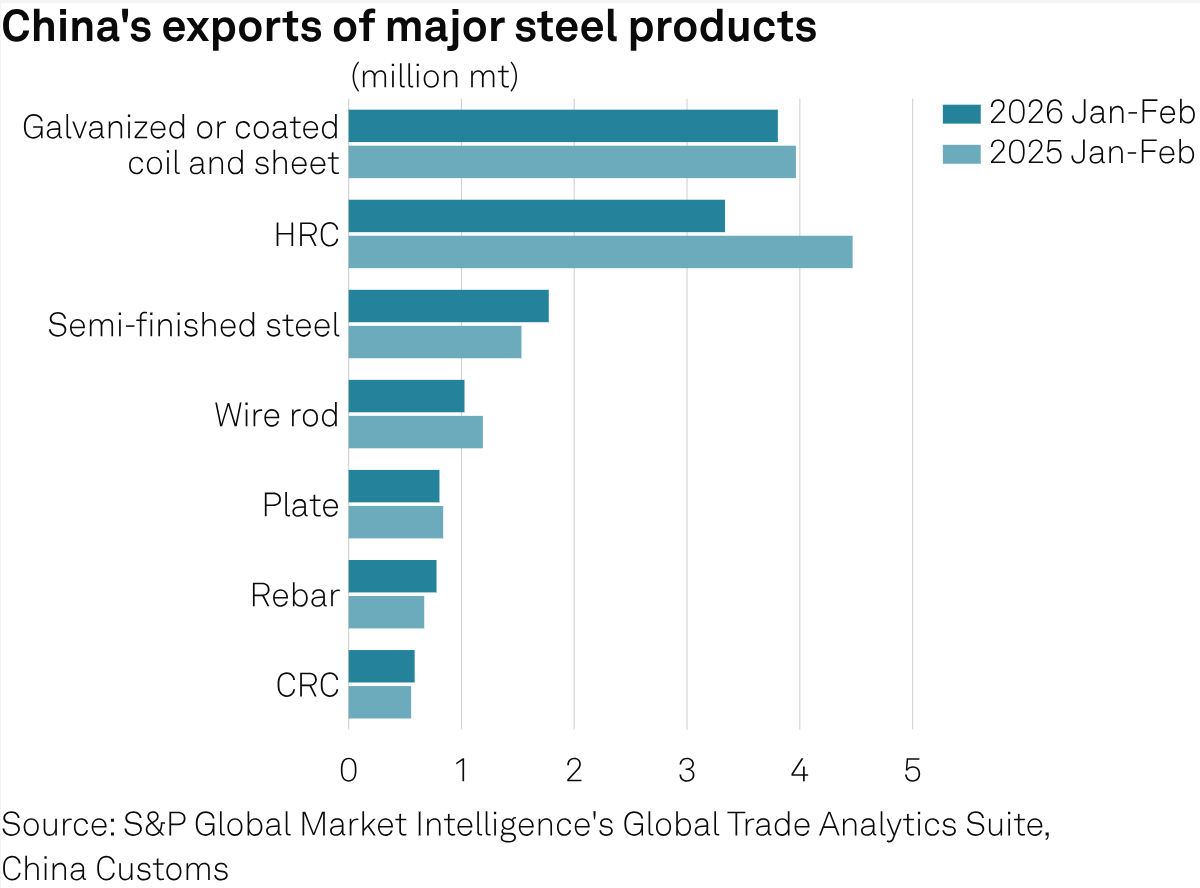
The main reason behind this is that Vietnam -- China’s largest HRC export destination -- and South Korea -- the fourth-largest HRC export market -- imposed antidumping duties on Chinese HRC in the second half of 2025.
However, Chinese billet remains competitive in Asia, given the low domestic prices, outcompeting material from Indonesia and Vietnam and displacing Russian billet in some cases, according to ferrous metals analysts at S&P Global Energy CERA.
China’s finished steel exports are expected to reach 105.75 million mt in 2026, down 11.1% year over year, while semi-finished steel exports will stay at a similar level to last year at 14.6 million mt, according to S&P Global Energy CERA.