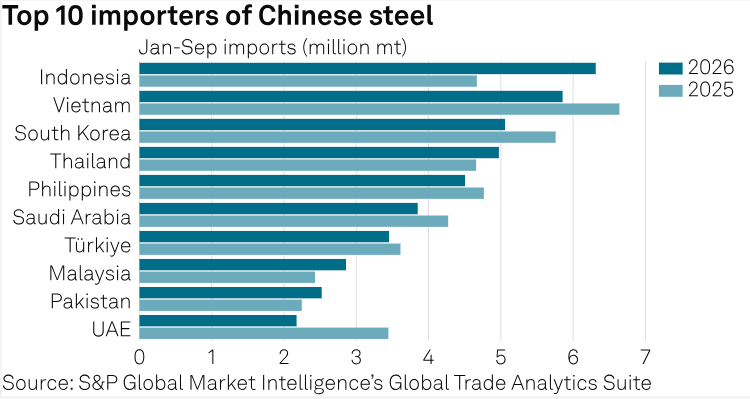
China's combined finished and semi-finished steel exports surpassed 100 million metric tons in the first nine months of 2026, reaching the milestone a full month earlier than in 2025, as persistently weak domestic demand and insufficient production cuts at Chinese mills continued to redirect steel volumes toward overseas markets.
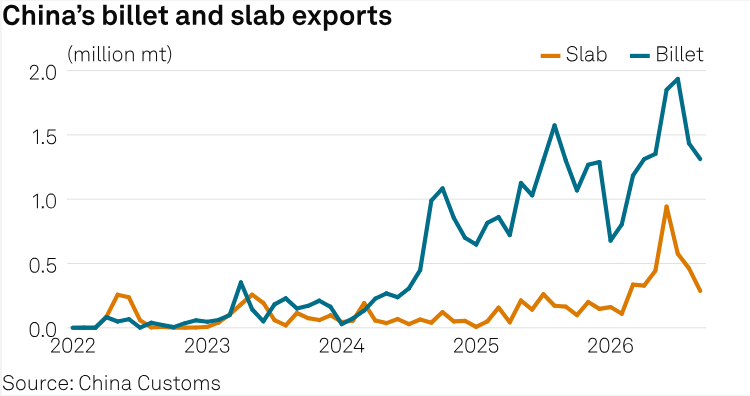
China's semi-finished steel exports totaled 1.609 million mt in September, down 16.5% from August but still 7.7% higher year over year, according to the latest China Customs data.
Within the total, slab exports were down by 37.9% from August at 286,843 mt in September, although they were 74.6% higher year over year. Billet exports fell 8.5% month over month to 1.312 million mt but were still 0.8% higher year over year.
China's combined exports of finished and semi-finished steel totaled 12.101 million mt in September, edging up 0.2% from August and 1.2% year over year.
Over January-September, semi-finished steel exports surged 45.8% year over year to 15.655 million mt, taking combined finished and semi-finished steel exports to 101.296 million mt, up 2.6% year over year.
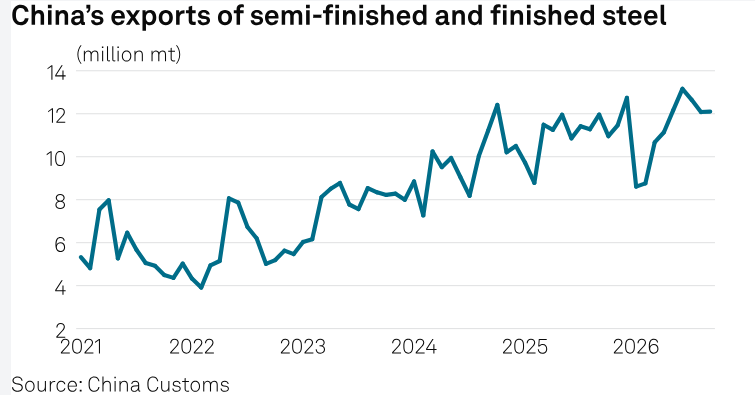
Total steel exports over the first nine months of the year were equivalent to about 14% of China's crude steel production during the same period, up from 13% a year earlier, according to Platts calculations based on China Customs and National Bureau of Statistics data.
Several China-based mill and trading sources said over Oct. 23-26 that overseas orders for both finished and semi-finished steel booked during June-August were relatively weak, resulting in lower export volumes during July-September compared with June.
However, bookings for both finished and semi-finished products improved noticeably in September, pointing to a likely rebound in China's overall steel exports in October and November, according to the sources.
According to two trading sources, export orders received in October were broadly unchanged from September.
Other mill and trading sources, however, said October bookings, which would mainly translate into December shipments, could edge lower from September based on their own businesses and broader market conditions.
They cited sluggish overseas demand, while the downtrend in Chinese steel prices and uncertainty over the direction of upstream raw material prices were also discouraging buyers from placing orders.
Despite the mixed outlook for December shipments, the sources generally expected China's finished and semi-finished steel exports to remain elevated during the fourth quarter.
Persistently weak domestic steel demand, coupled with insufficient production cuts by Chinese mills, is expected to cap any rebound in domestic steel prices during the fourth quarter, a trend that should continue to support exports, the sources said.
One trader and two mill sources said China's combined exports of semi-finished and finished steel products in 2026 were unlikely to fall below the 2025 level.
Among all the steel products, semi-finished steel exports have experienced the fastest growth in 2026, a second trader said.
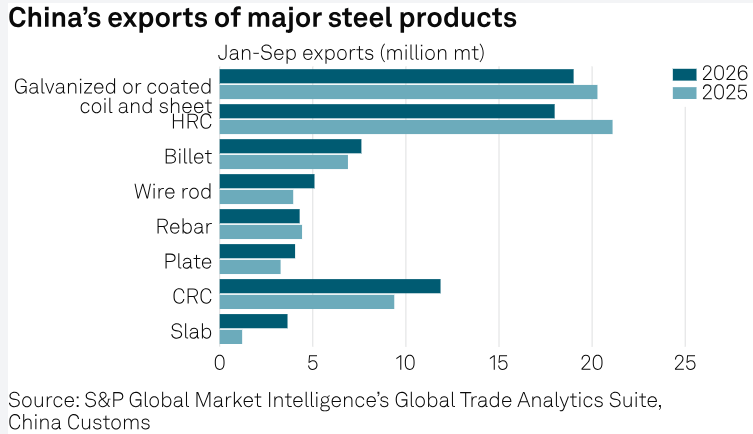
The trader added that China’s semi-finished steel, mainly billet and slab, has faced almost no antidumping duties in global markets, while the Russia-Ukraine war and conflicts in the Middle East have sharply reduced or eliminated billet supplies from these regions to global markets.
Although China's semi-finished steel exports declined further in September, shipments are expected to rebound over the coming months and remain at relatively high levels, according to the second trader.